Double Feature: Connect with Empathy, But Lead with Compassion / Stop telling managers to be empathetic. Try this instead

Friends,
Here are two insightful article about empathy, compassion, and leadership. There are a lot of ideas about empathy floating around these days so I thought I’d share some science and provide more context.
First, there is not just one type of empathy but three. We know this from neuroscience because different parts of the brain light up on MRI scans when the various types of empathy are activated. (Watch Daniel Goleman talk about it here.) The 3 kinds are:
Cognitive empathy: “I understand what you are thinking and feeling” (also called perspective-taking)
Affective empathy: “I feel what you are feeling” (also known as emotional empathy and what most people define as empathy)
Empathic concern (aka compassion): “I want to help you”
You may naturally exhibit one type more than another, and each type has its strengths and limitations. I tend to be more cognitively empathetic while my wife is more affectively empathetic. In the end, the goal is to have empathic concern/compassion and help out others. In my view, that’s what “lead with empathy” is about. (Not just having empathy, but doing something about it.)
As with most things in life, it’s about balance. Too little or too much of something can be counterproductive—for you, for others, or both. Sometimes we are too involved emotionally and we need take a step back so we can think more objectively. Other times we are being too logical and need to engage on an emotional level. Sometimes we need to act, and other times we need to refrain from acting. As is true for database solutions (I realize that was very nerdy), there is no “one-size-fits-all” solution for every situation. It takes wisdom and experience to balance things, and this usually involving practicing, making mistakes, receiving feedback and coaching, improving, and then rinse and repeat.
One of my favorite metaphors for this balance (and tension) is from Star Trek where Captain Kirk represents more of the emotional side and Spock represents more of the logical side. Sometimes Kirk was right and sometimes Spock was right. And yet, the reality is that they were better together than either of them was by themselves. They balanced each other. And that is what our right brains and left brains should do for us.
This topic is obviously an important one, and it requires a bit of thought…and practice. The good news is that, regardless of how low or high your empathy level is, you can grow in these skills. I am living proof of that. Let’s just say that nobody would have accused me of having empathy during the first 18 years of my life. And yet here I am helping other people grow in this very skill. Life is beautifully ironic!
Enjoy.
Connect with Empathy, But Lead with Compassion
https://hbr.org/2021/12/connect-with-empathy-but-lead-with-compassion
by Rasmus Hougaard, Jacqueline Carter, and Marissa Afton
For close to two years, leaders have been thrust into the role of Counselor in Chief, helping teams recover from the grief and loss of the pandemic, buoying the declining mental health of their employees, being sensitive to people’s anxieties and often publicly sharing their own vulnerabilities along the way. In short, they have been shouldering a big emotional burden.
Of course, this kind of empathy is important for good leadership. But too much of it can be a problem, weighing you down. So when we tell leaders that, actually, they don’t have to take the difficulties of the people they lead onto themselves, this is a huge burden lifted off their shoulders.
Instead of carrying that burden of empathy, you can learn to experience the uplifted experience of compassion. This is a massive shift in how leaders engage with their teams, a shift that greatly benefits all sides. It begins with understanding the difference between empathy and compassion.
Empathy and Compassion: What’s the Difference?
Let’s start with some definitions. The words “empathy” and “compassion,” as well as “sympathy,” are sometimes used interchangeably. They all represent positive, altruistic traits, but they don’t refer to the exact same experience. It is helpful to consider the two distinct qualities of compassion: understanding what another is feeling, and the willingness to act to alleviate suffering for another. The following image visually distinguishes compassion from the similar experiences of empathy, sympathy, and pity.
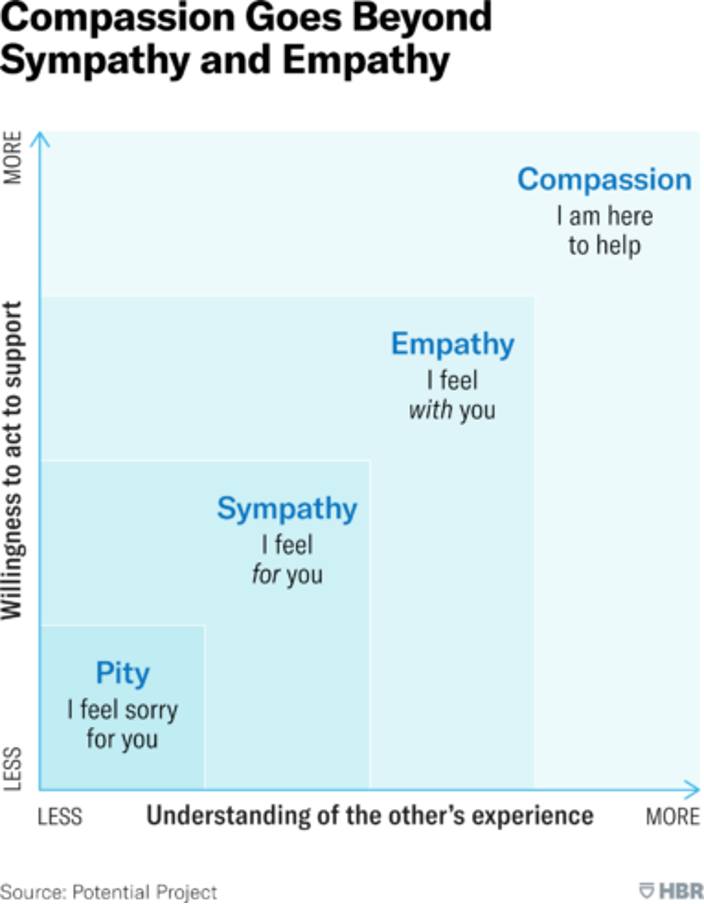
At the bottom left, we have pity. When we experience pity, we have little willingness to act and little understanding of another’s experience. We simply feel sorry for them. Moving up the chart to the right, we experience sympathy. There is a small increase in our willingness to help and our understanding of the other. We feel for the other person.
Moving up one more level, we come to empathy. With empathy, we have a close, visceral understanding of the other person’s experience. We feel with the person. We literally take on the emotions of the other person and make those feelings our own. Though a noble thing to do, it does not necessarily help the other person, except for possibly making them feel less lonely in their experience.
Finally, at the top right, we have a good understanding of what the other person is experiencing and a willingness to act. Our understanding of the other person’s experience is greater than with empathy because we pull on our emotional awareness as well as rational understanding. Compassion occurs when we take a step away from empathy and ask ourselves what we can do to support the person who is suffering. In this way, compassion is an intention versus an emotion.
Why Does This Matter?
Paul Polman, former CEO of Unilever, puts it this way: “If I led with empathy, I would never be able to make a single decision. Why? Because with empathy, I mirror the emotions of others, which makes it impossible to consider the greater good.”
Paul is right. Even with its many benefits, empathy can be a poor guide for leaders.
Empathy often helps us do what’s right, but it also sometimes motivates us to do what’s wrong. Research by Paul Bloom, professor of cognitive science and psychology at Yale University and author of Against Empathy, discovered that empathy can distort our judgment. In his study, two groups of people listened to the recording of a terminally ill boy describing his pain. One group was asked to identify with, and feel for, the boy. The other group was instructed to listen objectively and not engage emotionally. After listening to the recording, each person was asked whether they would move the boy up a prioritized treatment list managed by medical doctors. In the emotional group, three-quarters of participants decided to move him up the list against the opinion of medical professionals, potentially putting sicker individuals at risk. In the objective group, only one-third of the participants made the same recommendation.
As leaders, empathy may cloud our judgment, encourage bias, and make us less effective at making wise decisions. However, it should not be completely avoided. A leader without empathy is like an engine without a spark plug — it simply won’t engage. Empathy is essential for connection and then we can leverage the spark to lead with compassion.
And herein lies the challenge for most leaders: we tend to get trapped by our empathy, making us unable to shift to compassion.
Avoiding the Empathy Trap — and Leading with Compassion
Overcoming an empathetic hijack is a critical skill for any leader. In mastering this skill, you must remember that shifting away from empathy does not make you less human or less kind. Rather, it makes you better able to support people during difficult times. Here are six key strategies for using empathy as a catalyst for leading with more compassion.
Take a mental and emotional step away.
To avoid getting caught in an empathetic hijack when you are with someone who is suffering, try to take a mental and emotional step away. Step out of the emotional space to get a clearer perspective of the situation and the person. Only with this perspective will you be able to help. By creating this emotional distance, you may feel like you are being unkind. But remember you are not stepping away from the person. Instead, you are stepping away from the problem so you can help solve it.
Ask what they need.
When you ask the simple question “What do you need?” you have initiated a solution to the issue by giving the person an opportunity to reflect on what may be needed. This will better inform you about how you can help. And for the suffering person, the first step toward being helped is to feel heard and seen.
Remember the power of non-action.
Leaders are generally good at getting stuff done. But when it comes to people having challenges, it is important to remember that in many instances people do not need your solutions; they need your ear and your caring presence. Many problems just need to be heard and acknowledged. In this way, taking “non-action” can often be the most powerful means of helping.
Coach the person so they can find their own solution.
Leadership is not about solving problems for people. It is about growing and developing people, so they are empowered to solve their own problems. Avoid taking this life-learning opportunity away from people by straight-up solving their issues. Instead, coach them and mentor them. Show them a pathway to finding their own answers.
Practice self-care.
Show self-compassion by practicing authentic self-care. There is a cost to managing one’s own feelings to better manage others. Often called emotional labor, the task of absorbing, reflecting, and redirecting the feelings of other people can be overwhelming. Because of this, we as leaders must practice self-care: take breaks, sleep, and eat well, cultivate meaningful relationships, and practice mindfulness. We need to find ways of staying resilient, grounded, and in tune with ourselves. When we show up in the workplace with these qualities, people can lean on us and find solace and comfort in our well-being.
This article is adapted from Compassionate Leadership: How to do Hard Things in a Human Way by Rasmus Hougaard and Jacqueline Carter (Harvard Business Review Press 2022).
Stop telling managers to be empathetic. Try this instead
https://www.fastcompany.com/90695010/stop-telling-managers-to-be-empathetic-try-this-instead
by David Rock
David Rock, cofounder of the NeuroLeadership Institute, says when a leader is successful in recognizing a person in distress, taking perspective, and responding with meaningful action, the result is both people’s brains receive reward signals that trigger the release of brain candy (like oxytocin).
Empathy is the buzzword in today’s business lexicon. Work still isn’t normal. Millions of employees are still adjusting to frequently changing professional and personal demands, and we’re all collectively still traumatized by the events of the past 18 months. Leaders clearly need to be empathetic to support their teams and workforce. So it’s a good thing companies are starting to care about this concept more than ever, right?
It would be, except for three big problems.
First, our understanding and definition of empathy are all over the map. Some people think empathy is simply listening to people, while others think it’s about understanding individuals. Employees in a recent EY survey think of empathy as fairness and transparency, while a McKinsey report frames empathy around mental health support services. Other reports suggest inclusion is the true sign of empathy. All of this confusion makes the concept incredibly difficult to prioritize and set targets around, not to mention trying to measure the effectiveness of building empathetic muscles.
The second big problem is the confusing science around empathy. While it’s encouraging to see empathy deeply studied in neuroscience labs across the globe, scientific literature shows a contradictory language of empathy, encompassing a broad range of interpersonal cognitive and affective processes, and a term used to describe distinct processes under that umbrella.
There is also a dispute over whether it’s appropriate to group subcomponents under one all-encompassing term, because of the different parts of the brain involved in the processes. So not only do we have no good definition of empathy, but we also don’t have any clear alignment around the language of how it works in our brains, which means it’s difficult to measure or improve.
This brings us to the third problem with empathy. It turns out that some types of empathy are exhausting and difficult to maintain over time. Consider healthcare workers who experienced overwhelming exhaustion from dealing with the strong emotions of so many families grieving, while struggling with limited resources and working excessive hours. Practicing one type of empathy, which involves actively trying to see other people’s perspectives, takes a lot of cognitive resources, like doing complex math. When our mental resources are already taxed, as healthcare workers’ are, being empathetic in this way becomes a big issue.
But there is one type of empathy that, instead of exhausting us, can have the opposite effect: It can energize us. More importantly, it’s something that you can sustain over time. The lay term for this is compassion.
Compassion is the power tool for energizing leaders and teams. If we recognize someone’s distress and successfully understand why they feel that way, but fail to do anything about it, we have offered sympathy. Sympathy without action is akin to telling someone: “I understand what you’re saying, and even though I wouldn’t feel that way, I can see why you do, and I’m sorry you feel that way.” There is a cognitive understanding of the impasse, but neither person ends up feeling great about the result. But if you go the extra step to take action that’s meaningful to the person in distress, that’s compassion—a gift that comes with abundant, unexpected benefits.
Here’s why it works so well: Compassion promotes motivation in our brains because it makes both the receiver and the giver feel better. When a leader is successful in recognizing a person in distress, taking perspective, and responding with meaningful action, the result is both people’s brains receive reward signals that trigger the release of brain candy—those sweet chemicals like dopamine and oxytocin that make us feel happy, energized, and promote stronger social bonds. When that release of chemicals occurs, it creates momentum that allows us to be more socially collaborative and innovative, which increases productivity and outcomes.
Consider a manager who has just learned of an employee with a hardship—an event has clearly impacted them but it’s nothing the manager can resolve, such as a death in the family. Instead of merely offering a sympathetic statement like, “I understand this must be difficult for you,” a compassionate manager might change the statement to a question: “I understand this must be difficult for you, I have covered your shifts for you today, would time off, or uninterrupted work without meetings for a bit be helpful, or is there something more specific I can do to help?” Going the extra mile and taking real action in the face of difficulties makes all the difference when it comes to what happens in the brain.
Similarly, on an organizational level, acts of compassion can come in many forms. I recently heard about several: Leaders giving employees $500 annually to spend on physical or mental health services or subscriptions; two weeks off with pay for a firm-wide reset at the end of the summer; several mental health days added into time-off policies. All of these acts of compassion hit on the key idea of regeneration: they didn’t cause fatigue for givers and instead generated positive emotions on both sides.
To be sure, compassion is one of those terms that can make leaders feel squishy. If 68% of CEOs, according to one study, fear they’ll be less respected if they show empathy in the workplace, compassion is sure to set off alarm bells.
But compassion also has more impact on creating a culture of trust when there’s shared adversity and teams have experienced something difficult together. That’s because it helps create relatedness, synchronicity, and connections—a particularly powerful tool for leaders who are scrambling these days to retain employees. Perhaps in these times of shared trauma, leaders are more open to being human.
Research also shows the more we practice compassion the more our brains develop. Cortisol thickness changes and functional connectivity increases, literally making our brains better with every action we take to help another person.
While there’s no prescribed dosage for practicing compassion—a little goes a long way, and a lot goes even further. So ditch the idea of just being empathetic, and energize your teams with the power tool of compassion. In the end, giving to others turns out to be good for us all.