Interview with Nir Eyal: Personal Growth, Product Psychology, and Becoming an Indistractable Superhero
Friends,
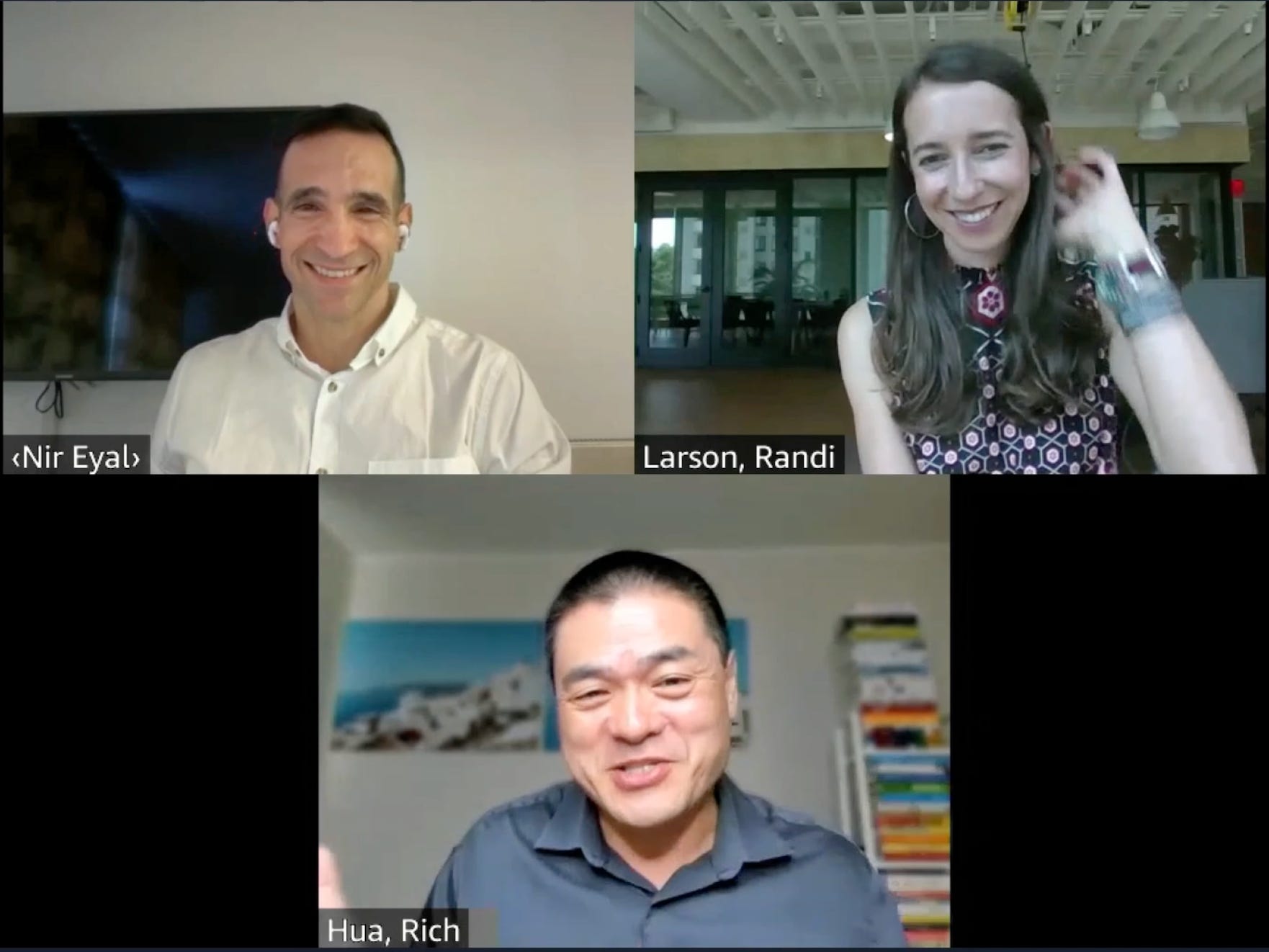
I recently had the pleasure of hosting Nir Eyal for an Amazon Talk. Nir is the bestselling author of "Hooked: How to Build Habit-Forming Products" and "Indistractable: How to Control Your Attention and Choose Your Life.” It was highly insightful conversation about personal growth, product psychology, and increasing our focus and productivity in a distraction-filled world.
Here are some highlights:
Distraction is the leading cause of death in the world today: Wait, what?! “Distraction, if you think about it, is the leading cause of death in the world today because the way I define it, distraction is any action that pulls you away from what you said you were going to do. So if you're smoking that cigarette, if you're overeating, if you're under-exercising, if you're distracted while driving, these are literally the leading causes of death for many people…Becoming indistractable is the skill of the century because there is no area of your life—your physical health, mental well-being, work—that isn't impacted by distraction.”
The opposite of distraction is not focus—it’s traction. “Both words come from the same Latin root trahere, which means to pull, and they both end in the same six letters, which spell ‘ACTION,’ reminding us that distraction is not something that happens to us. It’s an action we take. Traction is any action that pulls you towards what you said you were going to do, things that you do with intent, things that move you closer to your values, and help you become the kind of person you want to become. The opposite, distraction, is any action that pulls you away from what you said you were going to do, farther away from your goals, farther away from becoming the kind of person you want to become.”
Only 10% of distraction comes from the external triggers (that we love to blame)—phones, computers, people. 90% is from internal triggers. “What is an internal trigger? An internal trigger is an uncomfortable emotional state that we seek to escape. And it is the source of the overwhelming majority of our distractions. So what blew my mind in doing the research for this book is that we keep blaming the stuff outside of us, but really the source of distraction begins from within. It’s boredom, loneliness, uncertainty, fatigue, and anxiety. This is why we look for something to escape. So whether it's too much news or booze, football or Facebook, we are always going to find distractions somewhere if we don't understand the root cause of what we are looking to escape. And so that's why it's so absolutely critical that step number one to becoming indistractable is to master those internal triggers—or they will master you.”
4 steps to becoming indistractable:
Master internal triggers. When you feel boredom, anxiety, fatigue, etc., recognize them and learn to cope with them vs. avoid them. (This is a foundation of EQ, of course!)
Make time for traction. To Do lists are suboptimal. Time boxing is a much better way to gain traction. Research shows that setting an “implementation intention” is the most effective way to get things done. That means setting aside a time and place to do what you need to do. Allocate time for the most important work vs. just having a list of things to do.
Hack back external triggers. Identify and remove eternal triggers that don’t serve your goals (pings, dings, and meetings).
Prevent distraction with pacts: This is the last line of defense against distraction. Use “effort pacts” (make distractions harder), “price pacts” (add a financial disincentive to getting distracted), or “identity pacts” (commit to being the kind of person who is indistractable). For example, you can make a price pact to pay someone $10,000 if you don’t do what you say you’re going to do (e.g., submit your book draft by January).
The 10-minute rule is a powerful hack to become more indistractable. When you feel the pull of distraction (because you’re feeling bored, lonely, tired, etc.), set a timer and do that hard and important thing for just 10 minutes. The negative feelings will likely subside by that time, and you’ll be so immersed in the task that you will no longer want to divert your attention to something else.
AI will make indistractable people smarter and distractible people more distracted. “I think AI is going to make smart, indistractable people even smarter (and wealthier), and it's going to make people who are distractible even more distractible, and probably dumber. Somebody said, ‘The problem with AI is not that AI is getting smarter, it's that we're getting dumber.’ And I think for a lot of people that very much could happen if you outsource your brain and just let the AI do the work for you, and you don't question it. If you don't use it as a thinking tool but rather you use it as an answering tool, you've got a problem. I just finished writing my third book, and AI made it into a joy by doing all the things that suck about writing a book, like literary reviews and wordsmithing. But it's still up to me to find new original stories and research and to tell them in a compelling way and put them together.”
Everything worth doing in life is on the other side of discomfort. “If everybody could do it, if it was so easy, it wouldn't be special. What makes you special is that you're able to do the things that are difficult. I think our society is so enamored with everything being pain-free and easy and effortless that sometimes you're reminding yourself that, you know what, this emotional discomfort, it's just a feeling. Pain is the point. If something is difficult, that is a sign that it's worth doing."
I will leave you with two insightful quotes from Nir that were especially resonant to @Saba, Corey, one of our sponsors from the PLEX org:
"We are drowning in information but have a severe deficit in terms of the attention and focus to turn that information into wisdom."
“The most dangerous form of distraction is one that tricks you into prioritizing the urgent tasks and easy tasks at the expense of the hard and important work."
Nir also shared a handy free guide to Decode Your Distraction Triggers.
I wish you much success in becoming an Indistractable superhero!