Second-Order Thinking: What Smart People Use to Outperform
Friends,
A key to outperforming others is the ability to do second-order thinking. First-order thinking solves the immediate problem. Second-order thinking asks, "Then what?"
Most decisions fail because we stop thinking too early. Thinking beyond the obvious—considering the ripple effects over time and space—separates extraordinary performers from everybody else.
A simple way to do this is to use what I call the "10-10-10 method." What are the consequences of this decision in 10 minutes, 10 months, 10 years? Deeply and regularly considering this question will help you avoid traps and outperform others.
Why? Because most people only do first-order thinking, and they generally reach the same conclusions. Exceptional performance comes from deriving deeper, hidden insights with second-order thinking.
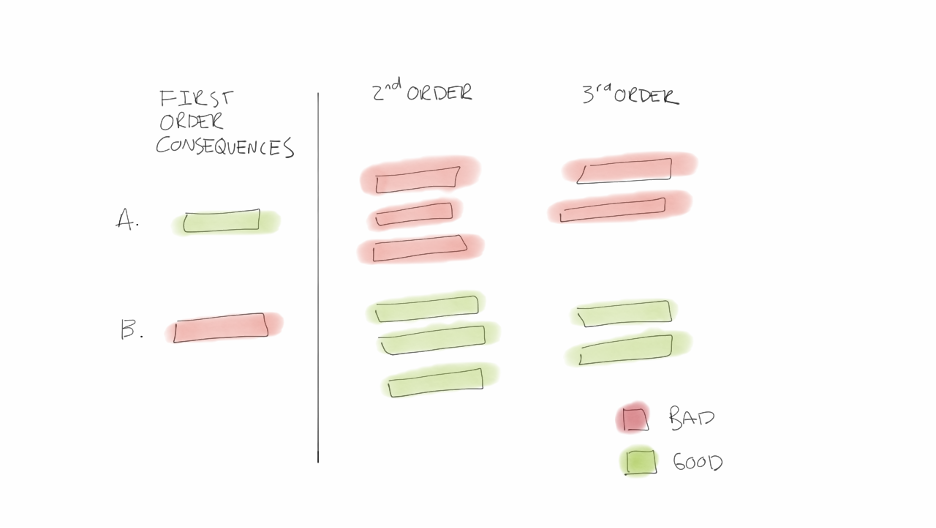
A profound reality is that superior results are often first-order negative and second order positive. It doesn't look or feel good in the short-term, but it pays off in the long-term. So many valuable things in life are like this: pursuing an education, getting physically fit, or trying something new and failing.
We have a Leadership Principle at Amazon called Ownership which says, "Leaders are owners. They think long term and don’t sacrifice long-term value for short-term results." The example that Jeff Bezos uses to explain this concept is of renters at a rental home during the Christmas holidays. They buy a Christmas tree and then realize they don't have a tree stand at the rental home. So they nail the tree into the hardwood floors. First-order problem solved! Obviously, they don't care about the second-order impact of damaging the floors. They are thinking like renters, not owners. We want owners at Amazon, and most businesses would want the same.
Do yourself a favor and engage in more second-order thinking. It isn’t easy, but it’s worth it!
Second-Order Thinking: What Smart People Use to Outperform
https://fs.blog/second-order-thinking/
by Shane Parrish
Understanding how to think things through – to push your mind past the first step – can help you solve problems, avoid problems, and take better actions.
The best way to examine the long-term consequences of our decisions is to think things through. This is called use second-order thinking.
It’s often easier to identify when people don’t adequately consider the second and subsequent-order impacts. For example, consider a country that, wanting to inspire regime change in another country, funds and provides weapons to a group of “moderate rebels.” Only it turns out that those moderate rebels will become powerful and then go to war with the sponsoring country for decades. Whoops.
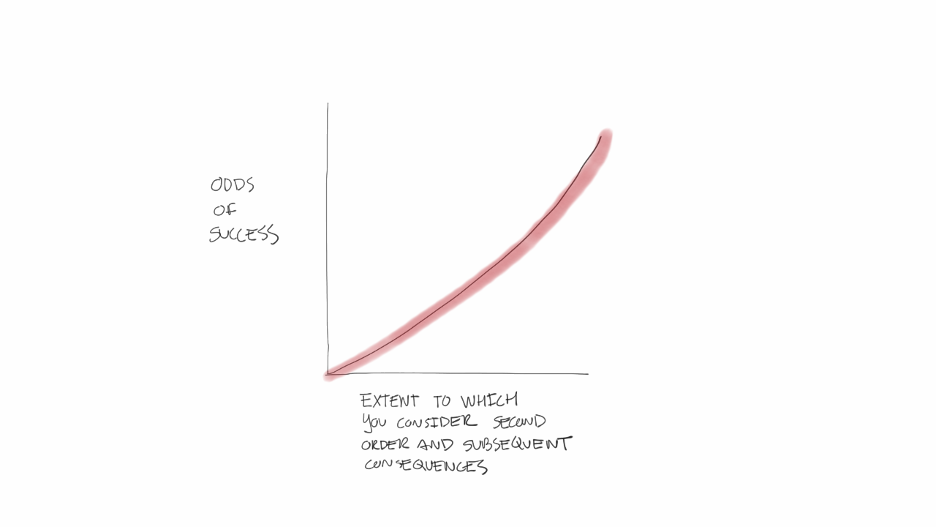
Failing to consider second- and third-order consequences is the cause of a lot of painfully bad decisions, and it is especially deadly when the first inferior option confirms your own biases. Never seize on the first available option, no matter how good it seems, before you’ve asked questions and explored.
Ray Dalio
The ability to think through problems to the second, third, and nth order—or what we will call second-order thinking for short—is a powerful thinking tool that not only solves problems but avoids them.
Second-Order Thinking
In his book, The Most Important Thing, Howard Marks explains the concept of second-order thinking, which he calls second-level thinking.
First-level thinking is simplistic and superficial, and just about everyone can do it (a bad sign for anything involving an attempt at superiority). All the first-level thinker needs is an opinion about the future, as in “The outlook for the company is favorable, meaning the stock will go up.” Second-level thinking is deep, complex and convoluted.
First-order thinking is fast and easy. It happens when we look for something that only solves the immediate problem without considering the consequences. For example, you can think of this as I’m hungry, so let’s eat a chocolate bar.
Second-order thinking is more deliberate. It is thinking in terms of interactions and time, understanding that despite our intentions our interventions often cause harm. Second order thinkers ask themselves the question “And then what?” This means thinking about the consequences of repeatedly eating a chocolate bar when you are hungry and using that to inform your decision. If you do this you’re more likely to eat something healthy.
First-level thinking looks similar. Everyone reaches the same conclusions. This is where things get interesting. The road to out-thinking people can’t come from first-order thinking. It must come from second-order thinking. Extraordinary performance comes from seeing things that other people can’t see.
Improving Your Ability To Think
Here are some ways to put second-order thinking into practice today.
Always ask yourself, “And then what?”
Think across time — What do the consequences look like in 10 minutes? 10 months? 10 Years?
Create templates like the second image above with 1st, 2nd, and 3rd order consequences. Identify your decision, think it through, and write down the consequences. If you review these regularly, you’ll be able to help calibrate your thinking.
If you’re using this to think about business decisions, ask yourself how important parts of the ecosystem are likely to respond. How will employees deal with this? What will my competitors likely do? What about my suppliers? What about the regulators? Often, the answer will be little to no impact, but you want to understand the immediate and second-order consequences before you make the decision.
A lot of extraordinary things in life are the result of things that are first-order negative, second order positive. So just because things look like they have no immediate payoff, doesn’t mean that’s the case. All it means is that you’ll have less competition if the second and third order consequences are positive because everyone who thinks at the first order won’t think things through.
Second-order thinking takes a lot of work. It’s not easy to think in terms of systems, interactions, and time. However, doing so is a smart way to separate yourself from the masses.