You Can Bend Systems to Your Will
What Moderna, Amazon, and neuroscience taught me about high agency

Friends,
It’s March 2020. New York is converting convention centers into makeshift ICUs.
Hospitals in Northern Italy are running out of ventilators. People are wiping down their groceries with Clorox wipes, afraid to touch a doorknob, and afraid to hug their own parents. The world is locked indoors, glued to a death count ticker that is climbing every hour. And the scientific consensus is clear: a vaccine will take 10 to 15 years to develop.
Moderna says, “No way.”
January 11: Chinese scientists post the genetic sequence of the novel coronavirus online.
January 13: Moderna’s team designs their vaccine candidate.
February 7: They produce the first batch of clinical-grade material.
February 24: They ship doses to the National Institutes of Health.
March 16: While the rest of us are panic-buying toilet paper (remember that?!), the first Moderna shot goes into a volunteer’s arm in Seattle.
Sixty-three days. From genetic sequence to vaccine injection. For context, the previous record for the fastest vaccine ever developed was four years (mumps in 1967).
How did Moderna’s scientists do this? They treated every rule of drug development as a suggestion. Steps that normally happen sequentially, they ran in parallel. They manufactured clinical-grade material before preclinical tests were finished. They invested hundreds of millions of dollars in manufacturing capacity based on incomplete data, at a level of uncertainty that would have paralyzed any normal pharmaceutical company’s review board. Their mRNA platform was designed to be reprogrammable (they’d been building it since 2010), so when the moment came, they plugged in the new sequence like updating a piece of software.
That’s high agency. Systems are bendable. “It’s never been done this fast” describes the past. It doesn’t dictate the future. And when millions of lives are on the line, the people who believe that are the ones who change history.
Working at AWS, I had a front row seat to the miracle unfolding before me. Moderna had built their entire drug development platform on our cloud. (The mRNA was designed to be “reprogrammable,” and running on cloud infrastructure meant they could scale their compute resources instantly when the moment demanded it.) But beyond the technical, my Amazon colleague, Phil, was friends with Moderna’s CEO, and he asked me if I could deliver an EQ session to their employees to support their mental health and resilience. To say they were under immense pressure is a woeful understatement.
I said, “Absolutely!” and I got to deliver an EQ session during a company all-hands in August 2020, just as they entered Phase 3 clinical trials with their vaccine. It was one of the greatest privileges of my life to do something to support their positivity and resilience while they were racing to save the world.
The rest is, of course, history. They created a vaccine in record time. The vaccine saved an estimated 20 million lives in the first year alone, equivalent to the total number of deaths from World War I. It was a miracle of modern medicine and technology, combined with ingenuity and high agency. But I think the deeper story is the one worth telling. Because right now, that same quality, that belief in your own ability to shape outcomes, is needed more than ever to create the world we’d like to pass on to our children.

The belief that changes everything
This is high agency: the belief in your ability to positively influence yourself and the world around you.
George Mack puts it elegantly: high agency means you believe that systems are bendable.
To gauge agency, he offers a fascinating thought experiment. Imagine you’re in jail in a foreign country and you get to make one phone call for help. Who you gonna call? (Ghostbusters aren’t available.) That person has high agency. They’re resourceful, persuasive, and get things done even when the rules aren’t on their side.
High agency people don’t wait for ideal conditions. They ship version 1.0 while everyone else is still debating whether to start. They work around blockers. They build smarter paths through broken systems. They don’t just do their job; they redesign it when needed.
It’s good to be slightly delusional
When people do something that’s never been done before, they are usually a bit delusional. But they possess the “right” amount. That’s just enough to think that what others consider impossible might actually be possible, but it’s mixed with the willingness to look at the facts and change their minds based on new data. Shane Snow calls this being “flexibly delusional.”
It’s a balance. If you’re too pragmatic, you stick with “what works” and don’t try new things. If you’re too delusional, you think you’re right no matter what and ignore anything that contradicts your beliefs. When you have the right amount, you believe you can succeed even if the odds are against you. So you actually try, which forces creativity and lateral thinking. But you also have the humility to change your mind and adapt when things aren’t working. This is in line with a famous line from Jeff Bezos: “Be stubborn on the vision, but flexible on the details.”
From one to 70,000
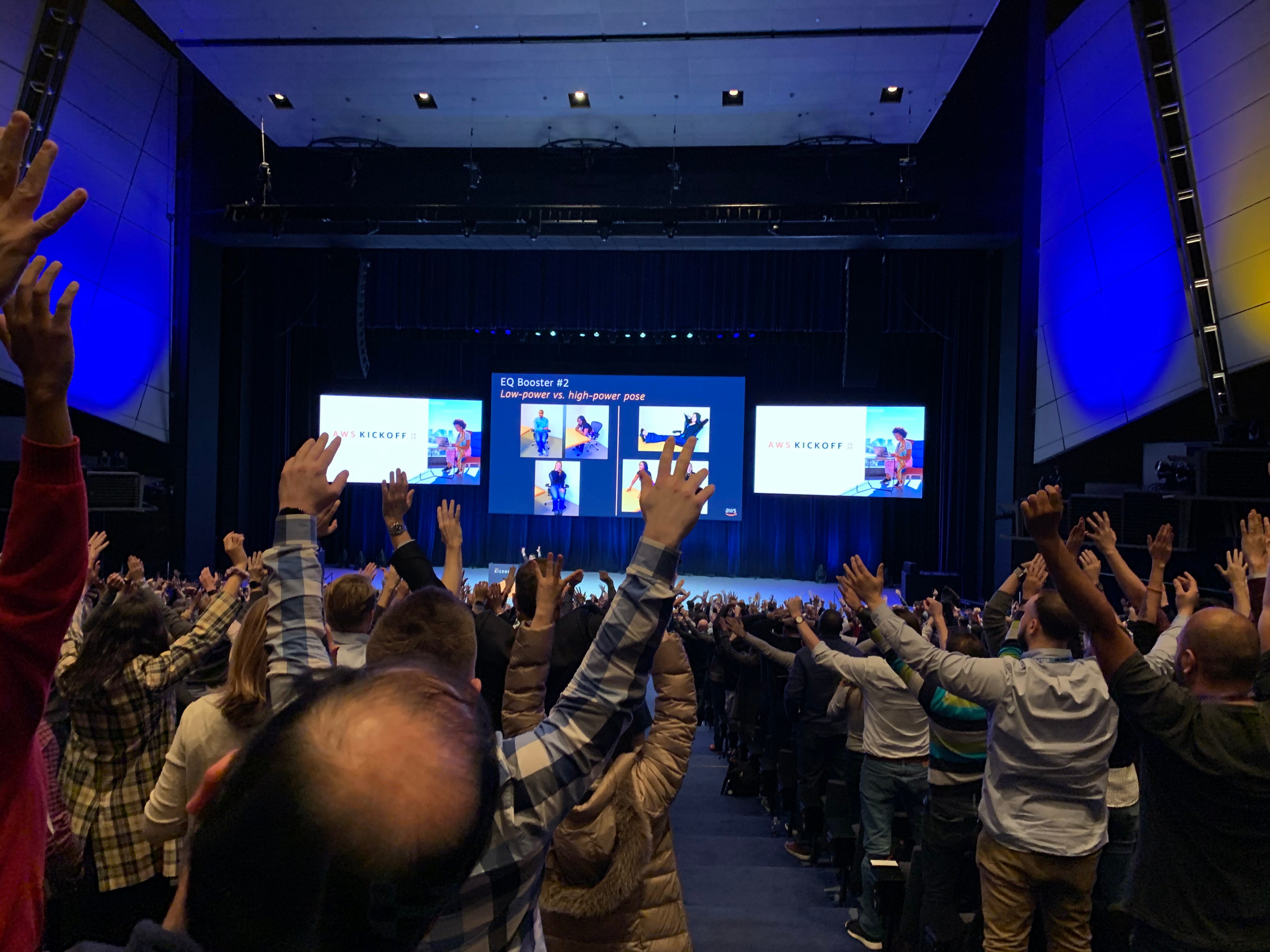
If you’ve been following my work for a while, you know that I built the EQ movement at Amazon from one person (me) to over 70,000 people. It was (and is) the largest EQ community at any single company in the world. I didn’t have a mandate for it. Nobody asked me to do it.
But I noticed that something was missing. Many of my colleagues were not performing as well as they wanted to. In leading, influencing, selling, collaborating, managing stress, or avoiding burnout. They were all really smart and were experts in their fields, but there were gaps when it came to self-awareness, self-management, empathy, and relationship management.
So I started solving for it by delivering EQ training sessions to whoever would listen. After a year of doing this, I’d reached about 4,000 people. Not bad considering it was completely off the side of my desk (my day job was Global Business Development Leader for Aurora PostgreSQL).
Then the pandemic hit, and the whole world changed. Every professional needed to figure out how to do their job while holed up at home and homeschooling their kids. Every manager needed to figure out how to deliver results while leading with empathy. These all required a higher level of emotional-social skills. Nobody was prepared for this. There was no official training program for these skills. So I stepped into the gap. I started delivering virtual training sessions to Amazon orgs on a global scale. Then I started training and certifying other volunteers to deliver these sessions. Together we reached 150,000 people in a little over two years. The EQ community of practice grew from 12 people to 70,000.
What we did visibly changed the culture of Amazon. One VP who oversees tens of thousands of people told me: “Thank you for building something truly special. The EQ movement you created has changed how we lead.”
Your brain’s factory setting is to “give up”
Nir Eyal recently shared some research in Harvard Business Review that floored me a bit.
For decades, psychologists followed Martin Seligman’s lead and assumed helplessness was learned. You experience enough setbacks and you give up. Makes intuitive sense.
Turns out it’s backwards.
In 2016, Steven F. Maier and Seligman used brain-imaging techniques that didn’t exist in the 1960s and overturned their own earlier conclusion. Passivity is the brain’s default response to sustained adversity. What has to be learned is the belief that effort matters. Maier identified a neural pathway for that learning. Seligman calls it the “hope circuit.” Here’s the wild part: you aren’t born with it. It is built through experience.
Read that again. The brain’s default setting is to give up under duress. Hope is the neurological “upgrade” you have to install.
So when your team seems frozen, people aren’t taking initiative, or the energy in the room feels low, the instinct is to call it a motivation problem or a talent gap. But the research points to something deeper: the hope circuit has gone dormant. The pathway that tells the brain “my effort changes outcomes” has been deactivated. Beautiful strategy decks and rousing town halls won’t reactivate it. Only direct evidence that action produces results will.
Upgrade your agency
So how do you level up your agency? Here are five practical things you can do:
Audit your current beliefs. “What am I accepting as fixed that I could actually change?” Most people have never examined the core beliefs that drive their big decisions. Write yours down. “I can’t pick up skills quickly enough” or “I can’t influence the direction of AI” or “I can’t be an inspiring leader.” Then apply what Nir Eyal calls the “usefulness test”: This belief may feel true, but is it useful? If not, discard it and pick a new one. Take action on it.
SET your mind for high agency. Research on explanatory style shows that how people explain setbacks determines whether they recover or stall. The critical variable: is a failure interpreted as pervasive, personal, and permanent, or specific, external, and transitory (SET)? “We’re not an innovative company” is permanent and pervasive. “We misjudged timing on this product” is temporary and specific. “I am an idiot and a failure” is personal and pervasive. “I didn’t do well on that presentation and will prepare better next time” is specific and transitory. Both are possible explanations, but only one preserves agency.
Control what you control. Differentiate between what you can control, what you can influence, and what you can’t control. Understanding the difference is key because you can focus your energy on the things you can control and influence. This produces results. Focusing on what you can’t control only creates self-induced disappointment (SID).
Bypass permission. Take one step without asking. Propose something, fix something, test something, build something. Without waiting for someone to say it’s okay or ask you to do it. It’s having a bias for action. You’ll be surprised at how many more things are possible when you don’t wait for the crowd’s approval.
High agency contagion. Make a list of people you know who have high agency. Plan to spend more time with them. Set up a recurring meeting. Agency is contagious. So is its absence. One of the most powerful groups we had at Amazon was the EQ Champions and EQ Evangelists. These were 800+ people who were all passionate about practicing, developing, and spreading EQ across their spheres of influence. They all had high agency mindsets, and every time we met up together, we elevated each other’s agency and spun the EQ@Amazon flywheel faster and faster.
The best way to use this list is to include it in your weekly review. That makes it a habit rather than just an aspiration.
Big thanks to Jorge Pando for several of these practices!
Create your system
I leave you with this question from Nir Eyal:
Is what I believe right now producing the results I want? Is it producing the leadership I need?
If the answer is no, it’s time to upgrade your mental-emotional operating system. That starts with an honest look at what you’re accepting as fixed that you could actually change. It continues with a system that pushes you to examine and adjust your beliefs on a regular basis.
As James Clear says, “You do not rise to the level of your goals. You fall to the level of your systems.”
Agency compounds over time. Let’s get going!
Be EPIQ,
Rich
✨ Join my upcoming courses
Dive deeper into high agency and other EPIQ skills in my upcoming masterclasses. I am offering two formats—a half-day mini-workshop and a two-day full course.
May 22 (mini-workshop): Human Skills: Your Competitive Advantage in the AI Era. Strengthen the core EQ competencies that will set you apart—from AI and from other highly capable professionals.
June 18-19 (full two-day course): Emotional Intelligence for Resilient, Adaptable & High Performance Leadership. (5 ⭐️ rating) Develop the EQ skills to perform at your best and lead teams that deliver sustainable high performance.
This was one of the most practical and engaging EQ courses I’ve taken. In just two days, Rich Hua combines science-backed frameworks with real-world application - so you’re not just learning concepts, you’re actively practicing them.
What stood out: 1/ Clear, actionable tools like “Moments that Matter” and reframing. 2/ Interactive peer coaching that builds real self-awareness 3/ A strong focus on behaviors you can apply immediately in your leadership.
I also appreciated the global cohort - learning from diverse perspectives made the experience even more impactful.
Gitanjali M, Technical Care Tier 2 Manager, Amazon Leo
Rich, thank you for investing your valuable time and infectious energy into developing the EQ skills and resilience needed to be a more empathetic leader. The practical, hands-on workshop was both engaging and rewarding, from the thought-provoking questions to the breakout small group sessions that fostered new ideas and ways of managing stress using the Attention Control technique and Reframing technique - turning a negative point of view to a positive one using the power of gratitude. Finally, you’ve inspired me to put into practice the EQ skills needed to become a more empowered and empathetic leader. Thanks to you, I am already utilizing the skills you taught me.
Jeff F, Customer Solutions Consultant
Rich Hua was a guest speaker for my Executive Presence class, sharing his deep expertise on Emotional Intelligence (EQ) with the students. Rich is a powerful and polished speaker who is an expert at simplifying the many pieces of EQ. He make EQ an approachable, actionable piece of Executive Presence. He helps students read the room, develop relationships, and manage their own emotions in high-stakes situations. Rich’s talk will be a mandatory part of the core course from this point forward because of his example and impact on students.
Ethan Evans, ex-Amazon VP